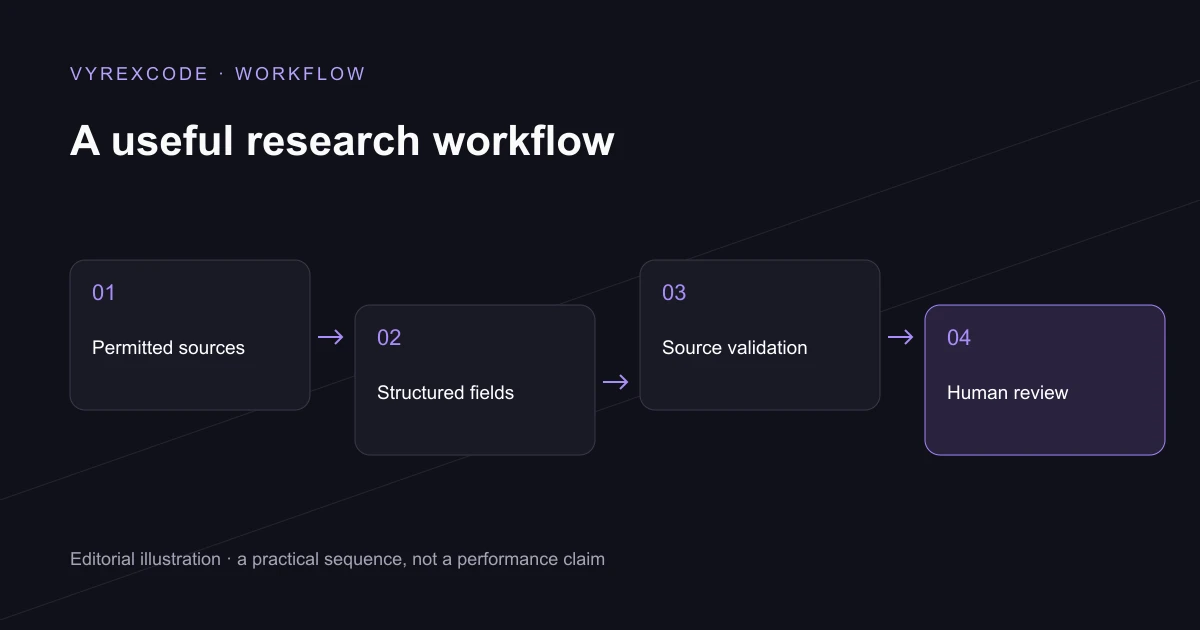
Begin with the enquiry and the permitted sources
Automated lead research can help organise potential business prospects from permitted sources into a reviewable list. Before building it, define the audience and the information your team actually needs. A large collection of unrelated contacts is not the same as a useful sales pipeline.
Start a lead research enquiry with the target industries, locations and business types. Explain how staff currently find and qualify prospects. VyrexCode can then assess whether structured collection, classification or a simpler process change is the right approach.
For lead research, identify the proposed sources before describing a scraper as ready to use. Access conditions, licensing and the information involved affect the scope. This is a bespoke system enquiry, rather than a claim that every website can be collected from without restriction.
Decide what makes a prospect useful
A practical lead research brief defines the qualification fields. You might need the company website, service category, location and a documented reason it fits the offer. Keep those criteria concrete enough that a person can review whether an entry belongs in the list.
AI can assist lead research by classifying a business description or organising evidence into agreed fields. Its output still needs validation against the source. A plausible sentence about a company's needs is not proof that the company needs your service.
Deduplication makes lead research more useful when the same business appears across several permitted sources. Define the record identity and preserve the source reference. VyrexCode can design the handoff so staff see one reviewable prospect rather than several disconnected copies.
Keep collection separate from outreach
Lead research does not by itself authorise sending marketing messages. The rules depend on the information, recipient type and contact method involved. Publicly visible details should not automatically be treated as unrestricted permission to contact an individual.
For UK lead research involving personal data, review the applicable data-protection and electronic-marketing requirements before collection or outreach. The ICO's business-to-business guidance is a useful starting point. Obtain advice appropriate to the actual campaign rather than relying on a general article as a compliance decision.
A lead research system should expose uncertain entries and allow staff to correct them. VyrexCode scopes source records, validation, access and retention with the intended workflow. The useful measure is the quality of accepted prospects and time saved, rather than the largest possible scraped count.
To discuss automated lead research, send VyrexCode an enquiry with your audience, proposed sources and intended use. Our AI automation agency UK service can assess the collection and review workflow. VyrexCode will scope the system before promising a feature list or a self-serve setup process.
What to include in the enquiry
Describe a small representative task, the systems that should receive accepted records and who approves the output. Include the fields that are essential and those that would merely be convenient. That makes the first version easier to evaluate and avoids collecting information with no clear purpose.
Agree how the system reports missing data, contradictory sources and collection failures. A blank or uncertain field is preferable to an invented contact detail. Keep the final decision about using a prospect with the responsible team.
Put the advice into practice
For a focused first version, choose one prospect category and a small set of permitted sources. The team can then evaluate whether the collected fields support a real qualification decision before expanding coverage.
Agree how corrections return to the workflow. A business that is unsuitable, duplicated or no longer operating should not keep reappearing simply because the source is collected again.
Read the business automation guide for the broader decision about using AI. A classification step may help, while other parts of the collection can be handled by ordinary software rules.
Include the intended record owner and review responsibility in the enquiry. A useful delivery is an inspectable workflow your team can operate, rather than a large file whose source and permitted use are unclear.