Define a conversion before adding a tag
SEO conversion tracking asks what visitors from organic search do after arriving on your website. A useful conversion is a meaningful business action, such as a qualified enquiry or a completed purchase. Loading a page and clicking a button can be useful journey events without being completed sales.
Start SEO conversion tracking by agreeing the event definition. For a store, decide whether you report placed, paid or fulfilled orders and how refunds are handled. For a service business, distinguish a form submission from an enquiry your team has checked and accepted.
Reliable SEO conversion tracking needs a stable connection between the landing page, source information and the eventual action. Preserve the relevant identifiers through the journey where the visitor's choices and the site's consent setup allow it. Do not send payment details or unnecessary personal information into marketing reports.
An anonymised store workflow
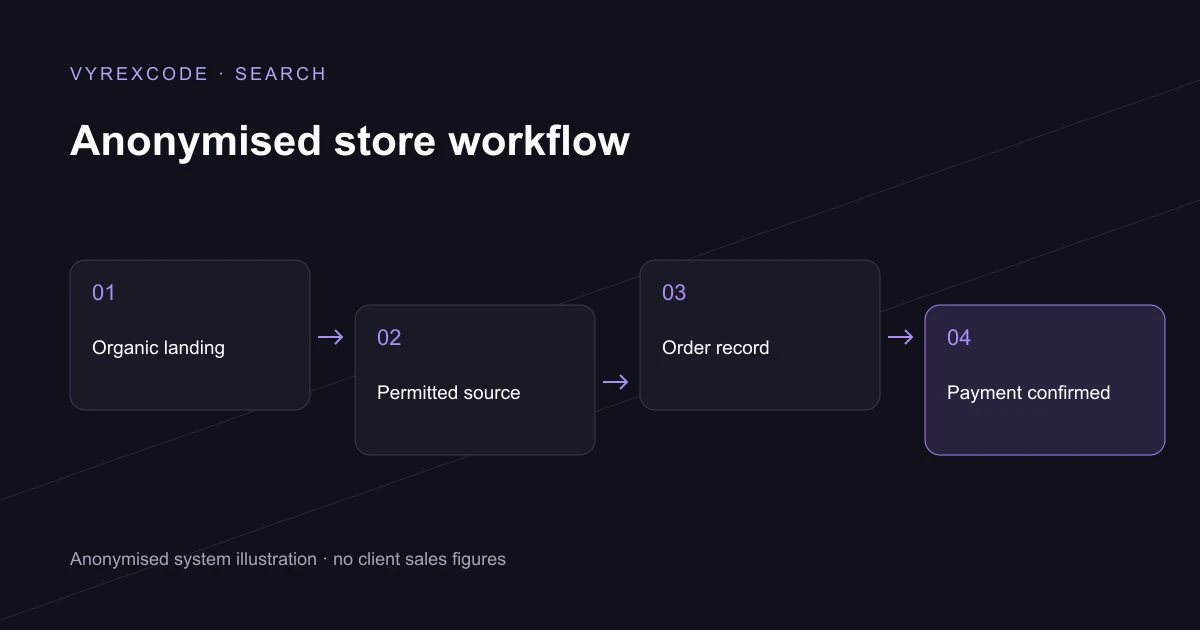
VyrexCode has built a store system connecting first-party attribution with orders and payment review. This SEO conversion tracking example follows the route from an organic landing page to a payment-confirmed order. The diagram uses anonymous labels so you can understand the workflow without exposing the customer's records.
The first step in SEO conversion tracking records the permitted acquisition context when somebody lands on a relevant page. The second records the order against the store's own order identifier. Payment reconciliation then determines whether that order should count as paid under the agreed reporting definition.
Keep the payment state visible in SEO conversion tracking. An order awaiting payment should not be counted as paid revenue, and a refunded order needs the treatment agreed for the report. Those distinctions let your team compare customer acquisition with the sales record it actually uses.
Connect search reports with sales records
Search Console supports SEO conversion tracking analysis by showing queries, clicks and the canonical pages receiving search traffic. It does not supply an individual visitor's search query alongside their order. Reporting a particular keyword as the proven source of a sale would need evidence that these reports do not provide.
Use landing-page groups for SEO conversion tracking when examining how organic traffic supports revenue. Compare the relevant organic visits and business events over the same period. Explain the attribution model and keep unknown or unconsented journeys visible as a limitation of the numbers.
A change ledger makes SEO conversion tracking more useful by recording what changed on each page and when. VyrexCode lines those dates up with search and conversion evidence. That comparison supports investigation; it does not prove every later sale was caused by the edit.
If your current reports stop at traffic, VyrexCode can scope SEO conversion tracking alongside managed SEO services. Bring your analytics setup, enquiry or order process and the definition of a successful conversion. We can identify the missing events and how to verify them.
Test the complete journey
Run an agreed test from the landing page through the form or checkout. Check that one completed action produces one event, that refreshes do not create duplicates and that the reporting record matches the operational record. Test failure and refund cases as well as the happy path.
Consent, blocked scripts, cross-device journeys and delayed purchases can leave gaps. Document those gaps rather than presenting a perfect attribution percentage. A smaller defensible number is more useful for decisions than an impressive total assembled from incompatible measures.
Put the advice into practice
An order accepted by the application may still be unpaid, cancelled or refunded. Choose the operational state that matches the business question and make that definition visible beside the report's totals.
For an enquiry business, pass an agreed qualification outcome back from the team's workflow. A submitted form can then be distinguished from a suitable request, without pretending the marketing system made the sales decision.
Use the order identifier to reconcile purchase events with the operational record. If a payment notification is delivered more than once, check that the report still counts the order once. Repeated notifications should not create additional sales.
Use the existing organic search case study for a separate visibility example. Search growth and paid-order attribution answer different questions and should retain their own source evidence.