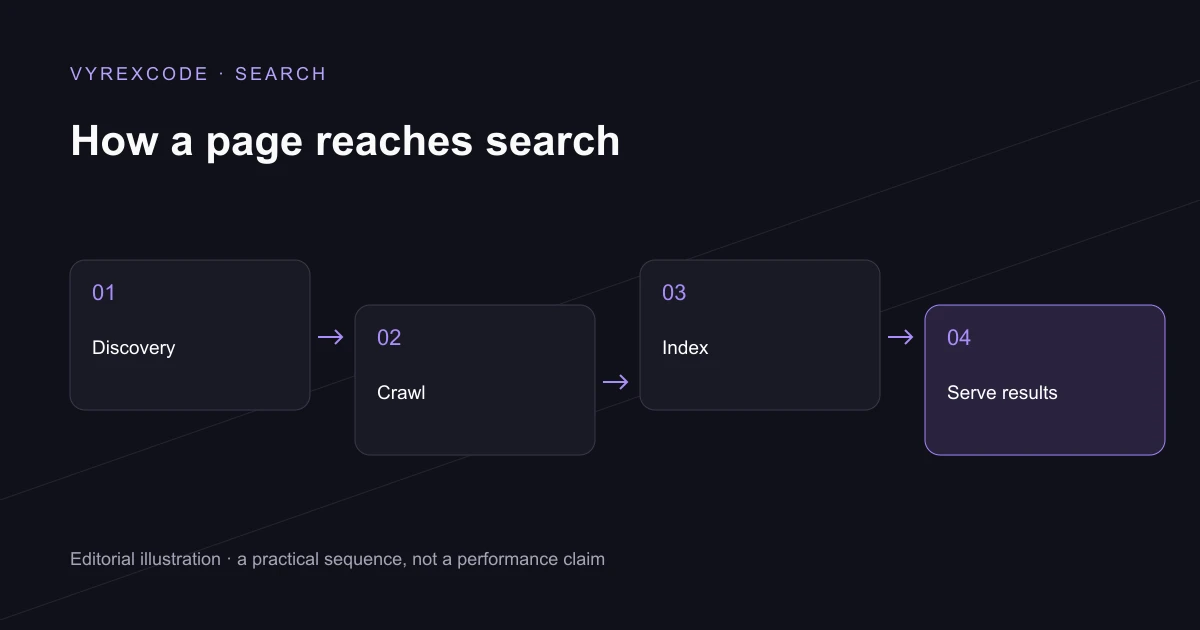
Discovery comes before indexing
Google indexing is the stage where Google analyses and stores information about a page it has crawled. It follows discovery and fetching, and it comes before a page can be considered for relevant search results. Those stages are connected, but they are not the same event.
A useful first step towards Google indexing is making the URL discoverable through ordinary crawlable links. An important guide should appear in the site's navigation or relevant content, rather than existing only in an internal document. A sitemap supplies another discovery signal.
Submitting a sitemap supports Google indexing by telling the engine which canonical URLs you want to highlight. It does not order an immediate crawl or guarantee inclusion. Keep the file accurate, with public pages that resolve and trustworthy modification dates.
What Google needs to process
Google generally fetches a page before analysing its content for Google indexing. Check that the server returns the intended page, that access is not blocked and that important content can be rendered. A request returning an empty shell or an error needs investigation at the site level.
Canonical selection affects Google indexing when multiple URLs contain the same or closely related content. A self-canonical indicates your preferred address, but it is a signal rather than absolute control. Align internal links, redirects and sitemap entries with the same intended URL.
A noindex instruction asks for exclusion from Google indexing when Google can access and read it. Do not confuse that with blocking crawling through robots.txt. If a crawler cannot fetch a page, it may not be able to read the page's noindex directive.
Inspect the actual URL
Search Console's URL inspection helps investigate Google indexing for a specific page. Compare the known indexed state with the live-page test where available, and read the stated reason carefully. A live test showing accessibility is not a promise of later inclusion.
Google indexing can take different amounts of time across pages and sites. Google does not guarantee that every compliant page will be crawled, indexed or served. Avoid suppliers promising a fixed inclusion deadline that they cannot control.
When Google indexing appears stuck, check whether the page adds an independent useful answer. Repeated doorway copy, soft errors and conflicting signals can require a content or technical fix. VyrexCode reviews those causes before simply resubmitting the same unchanged URL.
For help with Google indexing problems, VyrexCode offers managed SEO services covering technical investigation, content and public verification. Bring the affected URLs and the inspection evidence. VyrexCode can then separate a discovery issue from a rendering or canonical problem.
After a page is included
Inclusion does not prove that the page ranks for your target query or receives useful visits. Review the performance report separately, then follow the landing-page customer journey. Discovery, indexing, ranking and conversion answer different business questions.
Keep launch checks in the release record: response, canonical, robots instructions, incoming links and sitemap membership. That evidence makes a later diagnosis faster because you can compare the current state with a known good publication.
Put the advice into practice
For a newly launched guide, first check that a relevant public page links to it. A URL existing on the server does not by itself establish a useful discovery route for people or crawlers.
For an older URL that disappeared, inspect redirects, canonical changes and template releases around the observation date. A current problem may come from a shared site change rather than a flaw in that article's wording.
Read the ranking guide once the access and inclusion questions are resolved. A page can be included yet still need a better answer for the intended search.
Treat sitemap submission as a recorded request and inspect the subsequent processing state. A successful submission message is useful evidence of delivery, while actual inclusion requires a different observation.