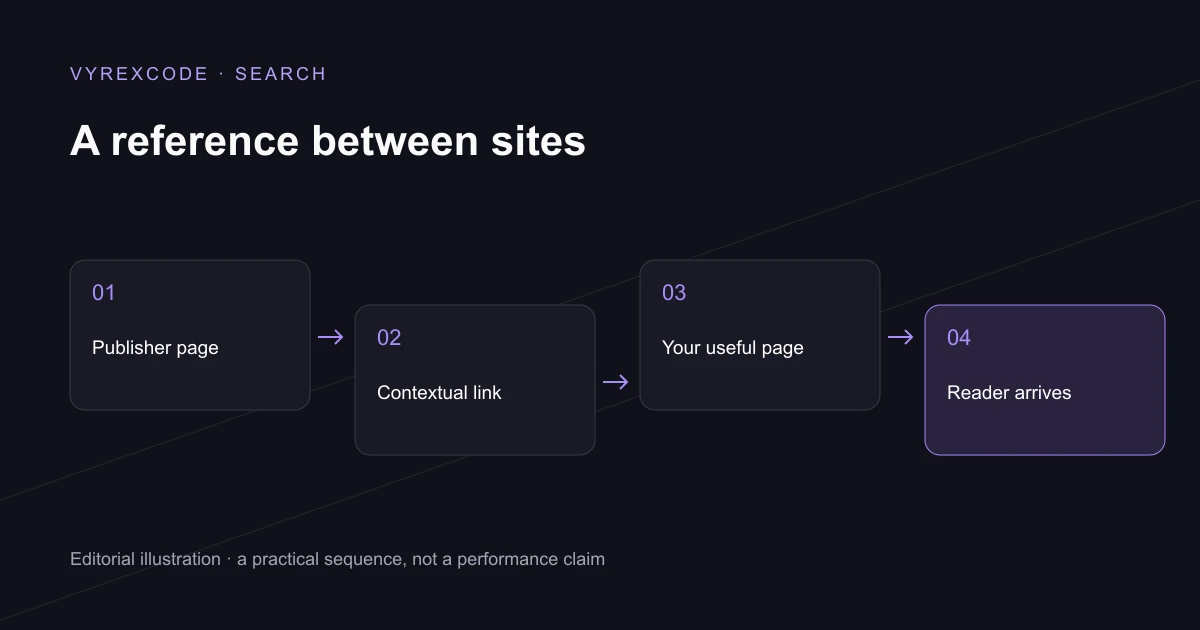
A link pointing from another website
Backlinks are links on other websites that point to a page on yours. If an industry guide references your explanation and links to it, that is an inbound reference for your site. The same link is outbound from the publisher's point of view.
Backlinks differ from internal links, which connect pages within the same website. Both help people move between useful answers, but they come from different places. A link from your own blog to your service page does not become an external reference simply because it uses a commercial keyword.
People can follow backlinks directly, creating referral visits. That audience value is worth considering separately from search performance. A well-placed reference in a small specialist publication may be useful even when a broad authority metric makes it look modest.
What makes a reference useful
Relevant backlinks fit the explanation around them. The anchor should give a reader a fair idea of the destination, and the linked page should deliver something useful. A random reference inserted into an unrelated article has a weaker editorial purpose.
Search engines can discover pages through backlinks, alongside other routes such as internal navigation and sitemaps. Discovery does not guarantee that the destination will be indexed or rank for a particular query. Treat those as separate observations.
Google's systems use link analysis among many ways of understanding pages, but backlinks do not operate as a simple public points total. VyrexCode looks at the reference, destination and wider site context rather than promising a fixed ranking benefit for each link.
Link attributes and commercial placements
Publishers can qualify backlinks with attributes such as sponsored, nofollow and ugc. These communicate information about the relationship or context. An attribute does not make a misleading article useful, and a useful article still needs the correct treatment for a paid placement.
Paid backlinks should be qualified according to Google's policies, normally with sponsored or acceptable nofollow treatment. A supplier offering payment for unqualified ranking credit is making a proposition you should examine carefully. A placement fee does not guarantee an organic result.
You can inspect backlinks by opening the actual page and following the reference. Check the surrounding explanation and the destination, then use an appropriate technical inspection to confirm the link attributes. VyrexCode records the observed result rather than relying on a spreadsheet entry alone.
If you want help deciding where backlinks fit your campaign, VyrexCode offers managed SEO services. We can review the useful pages you already have and whether relevant references are the next priority. Stronger content or a technical repair may need to come first.
Earn references through useful work
Give other people a concrete reason to cite the business: an original resource, a clear explanation, genuine project evidence or a helpful contribution to their subject. Outreach works better when the reference improves the publisher's article.
Keep a dated record of important placements and revisit them occasionally. Publishers can edit or remove pages, so a verified reference is an observation at a point in time rather than a permanent guarantee.
Put the advice into practice
Some backlinks point to the homepage, while others point to a specific explanation or service. The best destination depends on the reason for the reference. Useful backlinks should take the reader directly to the information the surrounding article promises.
Backlinks can disappear when a publisher edits or removes a page. Keep the important references in a dated record and recheck them when needed. An old list of backlinks describes a past observation, rather than proving that every placement remains live today.
For a campaign decision, read when to prioritise link earning. It explains why a destination repair or a clearer service page can matter more than pursuing another reference immediately.
For a purchase decision, read how to inspect a backlink offer. Checking the actual publisher and placement terms is a different task from understanding what an inbound link means.